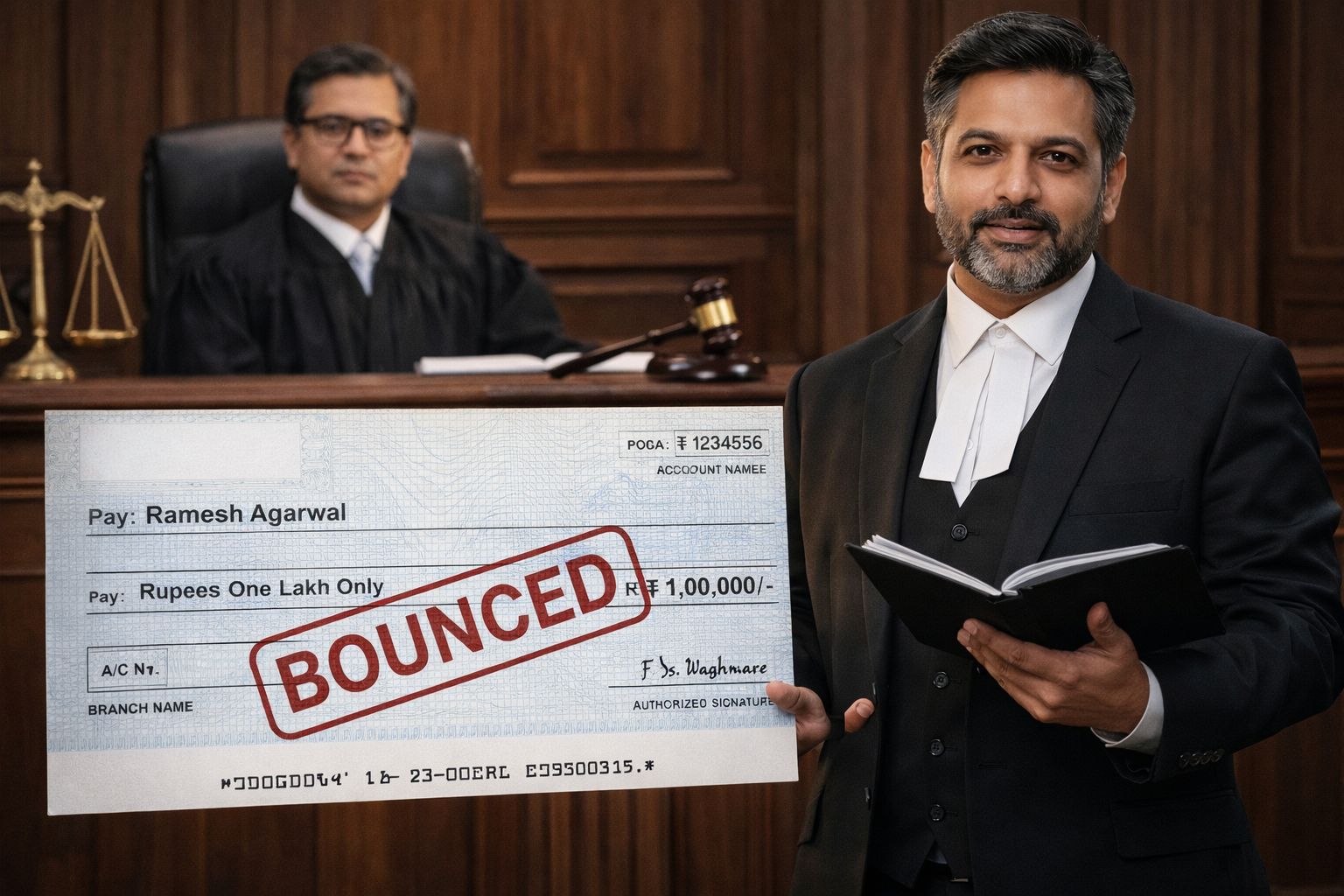
Introduction
At the Chamber of Advocate Rohit Gour, we recognize the stress and complexity involved in cheque bounce matters. Our team delivers strategic, client-focused legal solutions for both complainants and accused under Section 138 of the Negotiable Instruments Act, 1881. Renowned as one of Delhi’s leading cheque bounce lawyers, we provide practical, result-oriented representation across all major courts.
Jurisdiction for Filing Cheque Bounce Complaints
Recent amendments have simplified jurisdiction rules. Now, the cheque holder can file a complaint in the court where their bank account is maintained or their home branch is located. This reform eliminates confusion and ensures faster access to justice.
Understanding Section 138 NI Act
Section 138 applies when a cheque issued for a legally enforceable debt or liability is dishonored due to insufficient funds or other reasons. Penalties include:
- Imprisonment: Up to 2 years
- Fine: Up to twice the cheque amount
- Or both
Conditions for applicability:
- Cheque presented within validity
- Notice issued within 30 days of dishonor
- Payment not made within 15 days of notice
Presumption in Favor of Payee
Under Section 139, the law presumes that the cheque was issued for a valid debt unless proven otherwise. This shifts the burden of proof to the accused, making cheque bounce litigation unique compared to other criminal trials.
Step-by-Step Process in Cheque Bounce Cases
- Filing complaint under Section 138 NI Act
- Pre-summoning evidence under Section 202 Cr.P.C.
- Summoning and appearance of accused
- Framing of notice under Section 251 Cr.P.C.
- Complainant’s evidence
- Statement of accused under Section 313 Cr.P.C.
- Defence evidence
- Final arguments
- Judgment
Landmark Judgments
Recent Supreme Court rulings have streamlined cheque bounce litigation by enabling:
- Electronic summons
- Digital settlements
- Real-time case tracking
These measures aim to reduce delays and encourage early resolution.
Updated Compounding Rules
- Before defence evidence: Pay cheque amount only
- After defence evidence but before judgment: Additional 5% cost
- During appeal: 7.5% cost
- Before Supreme Court: 10% cost
Courts actively promote mediation and Lok Adalats for early settlements.
Key Features of Cheque Bounce Litigation
- Bailable and compoundable offence
- Presumption in favor of payee
- Appellate courts can order deposit of 20% of fine during appeal
- Fast-track reforms for quicker resolution
Our Cheque Bounce Legal Services
- Handling Section 138 NI Act cases
- Recovery of outstanding payments
- Issuance of legal notices
- Criminal complaints for dishonored cheques
- Negotiation and settlement support
Why Choose Advocate Rohit Gour?
- Proven expertise in cheque bounce litigation
- Representation in Saket, Dwarka, Rohini, Tis Hazari, Karkardooma, Patiala House Courts, Delhi High Court, and Supreme Court of India
- Strategic approach for quick recovery
- Client-focused and confidential handling
Frequently Asked Questions (FAQ)
1. What is a cheque bounce case under Section 138 of the NI Act?
A cheque bounce case arises when a cheque issued for a legally enforceable debt or liability is dishonored due to insufficient funds or other reasons. Section 138 of the Negotiable Instruments Act, 1881 governs such cases.
2. What are the penalties for cheque bounce in India?
The law prescribes:
Imprisonment up to 2 years
Fine up to twice the cheque amount
Or both
3. Where can I file a cheque bounce complaint?
As per recent amendments, you can file the complaint in the court where your bank account is maintained or your home branch is located. This simplifies jurisdiction and speeds up the process.
4. What is the time limit for sending a legal notice after cheque dishonor?
You must send a legal notice within 30 days of receiving the bank memo stating cheque dishonor. The drawer then has 15 days to make the payment.
5. Is cheque bounce a criminal offence?
Yes. Cheque bounce under Section 138 NI Act is a bailable and compoundable criminal offence.
6. Can cheque bounce cases be settled out of court?
Yes. Courts encourage mediation and Lok Adalats for early settlements. Compounding is allowed at various stages with nominal costs.
7. What happens if the accused does not appear in court?
If the accused fails to appear after being summoned, the court may issue a bailable warrant and later a non-bailable warrant.
8. How long does a cheque bounce case take to resolve?
With recent reforms like electronic summons and digital settlements, cases are being fast-tracked. However, timelines depend on complexity and cooperation of parties.
9. Can I claim interest on the cheque amount?
Yes. Courts often allow interest or compensation in addition to the cheque amount, especially in delayed payments.